My Etsy Shop

Sunday, March 31, 2024

Mary Stuart Collar, Antique Crochet

This is an antique crochet collar pattern. I think the pattern is from prior to the 1860s. Like many antique patterns, I don't know how well it has been proofread or test crocheted. A lot of these antique patterns havent been.
It's called the Mary Stuart collar.
I'm using DMC cebelia size 30 thread with a 1.1mm hook.
I like working antique thread patterns. The problem is, I dont like ruffles. Ruffled fabric is definitely an 1800s fashion! The collar probably is designed to be starched so that the ruffles and lace stand out. However, I dont have the patience to starch many of my patterns. I just wet block them and that's it.
I'm mostly following the spirit of the pattern. In this picture, I am doing a sc along the neck edge to stabilize it. The pattern asks for one more row of shells after this.
The book as of this date is available on Google Books.

See you later!
-BP

Thursday, November 30, 2023

Sweater Blowout and Mending

Hello fiber loving folks!

I hope your holiday season has started off well. I'm here trying to prepare for art shows and sales, while still studying my online courses.
And of course, there is holiday shopping to do for friends, family and myself. I am topping off for myself on supplies I need to keep creating and selling.
In the meantime, its sweater season! I'm frantically knitting a Central Park Hoodie (I will show it later). I love hoodies because they keep my neck and head warm, instead of me having to wear a hat and scarf around. That's two less items for me to remember when I'm going out the door.
Honestly, I should make time to inspect my sweaters each year. Twice a year if I had the time.
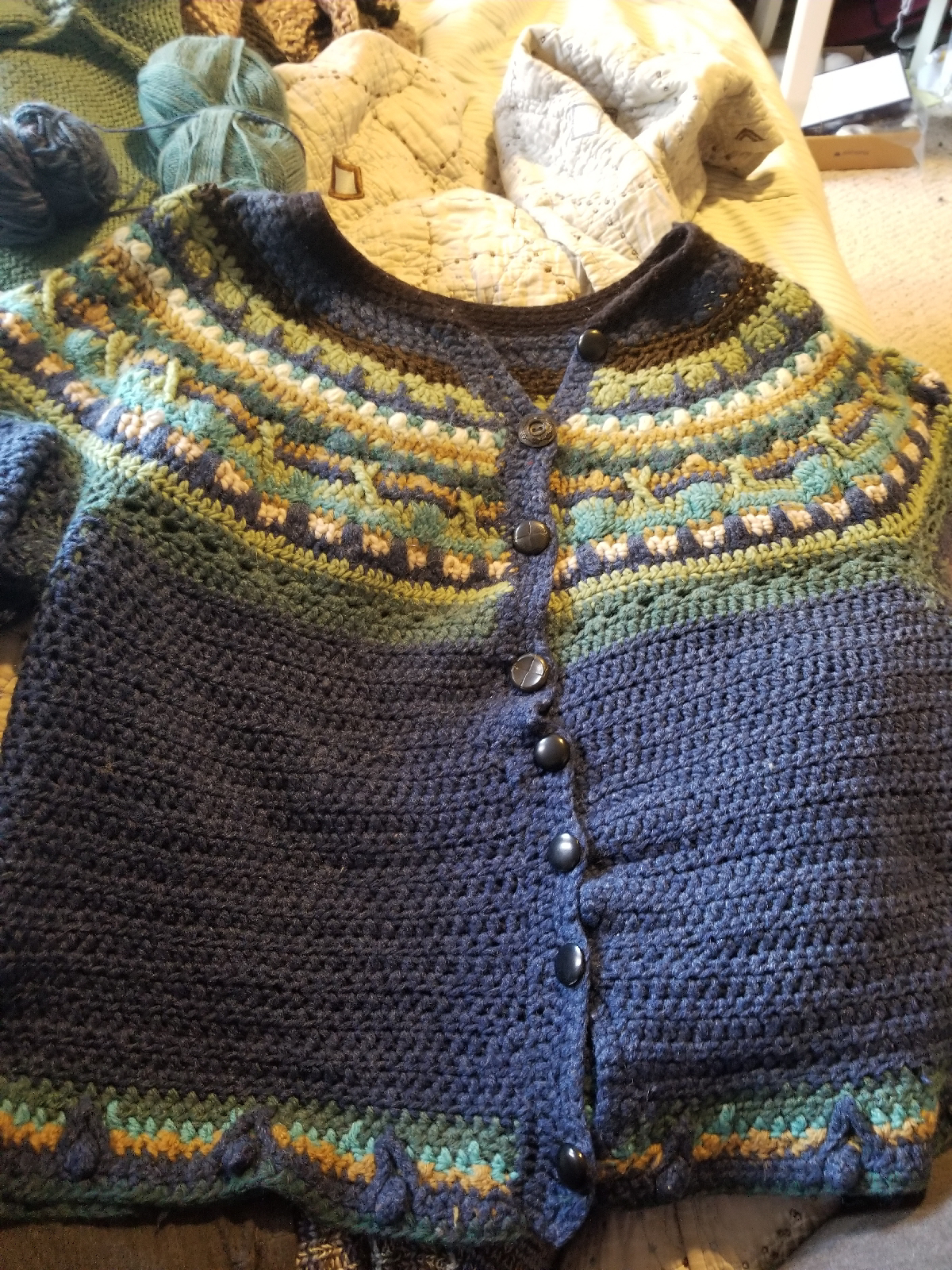
This is a top down circular yoke crocheted sweater made from scrap yarn and a recycled thrift store sweater. The body is done in half double crochet (US). The colors are navy for the body, and greens and teals for the yoke, hem and cuffs. I improvised the entire thing from a picture. 
This is my second time having to mend it, but it had served well over these years.
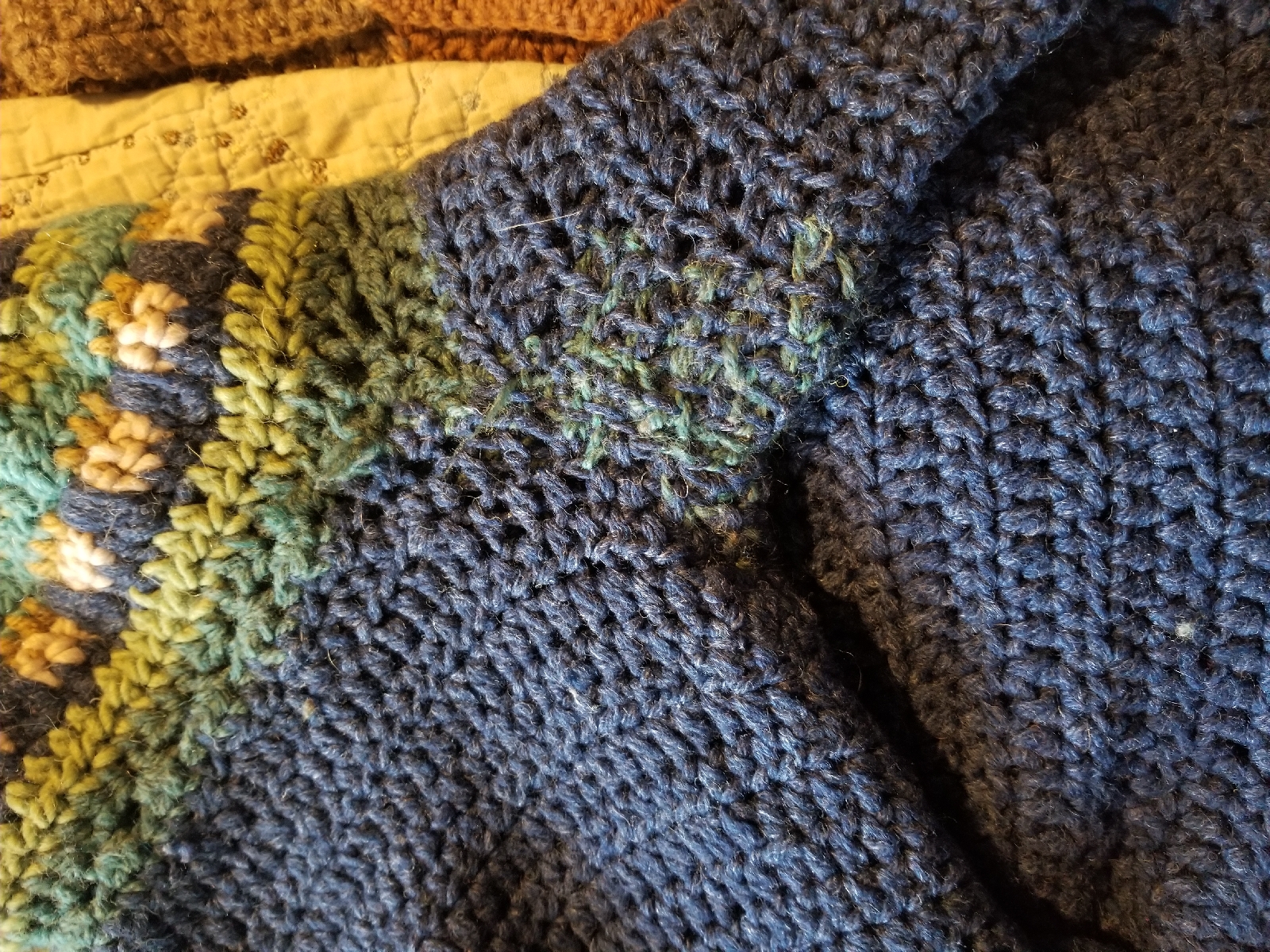
This is the underarm mending:
I have no more of the original sweater obviously, so I had to use a similar yarn for the underarms. Patons Classic wool in teal?
I'm going to use a handspun merino wool blue in a slightly lighter shade to fix the elbow hole. I will reinforce the other arm at the same time. Wish me luck!

-BPD

Sunday, August 13, 2023

Car Blanket/Pillow pattern colors

Hello folks.

These past two years, I have been working on de-stashing and using up my yarn and thread. This has involved a lot of knitting, crocheting and tatting of projects. I've even donated some yarn, patterns and supplies to specific charities. I have enough needles to supply a small beginner knitting or crochet class.
I've decided to let someone else take that on, by donating my excess supplies to community centers and programs.

However, sometimes you want to make usable things for yourself with all that yarn. Understandable, right? My stash is from family members, gifts, and from when I went a bit crazy as a new fiber artist buying pretty yarn wherever I saw it, especially on sale.
I think I am mostly over this. I don't know how far I want to go with de-stashing. I still have to spin up a lot of fiber, so I shouldn't have problems finding yarn in the future!

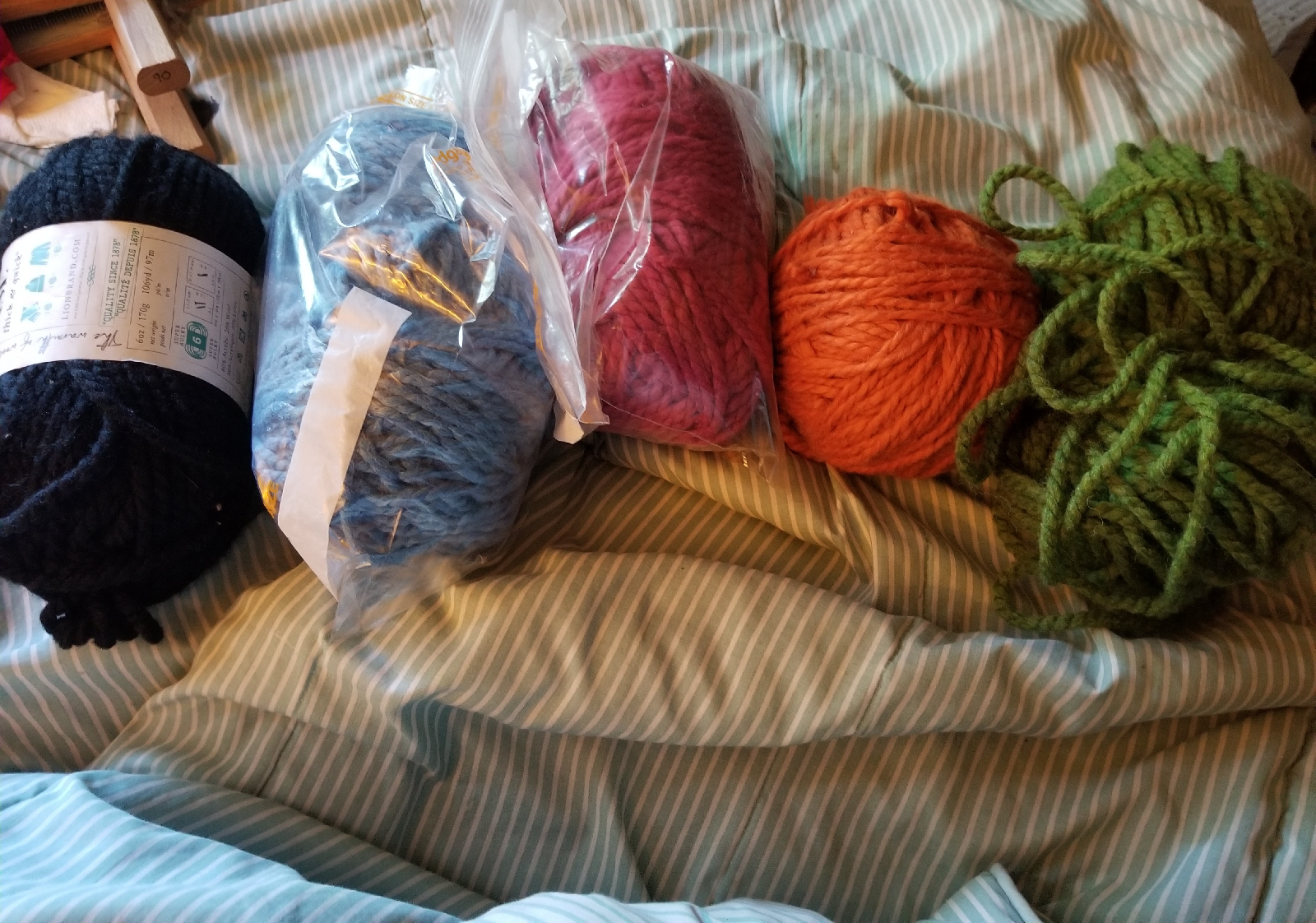
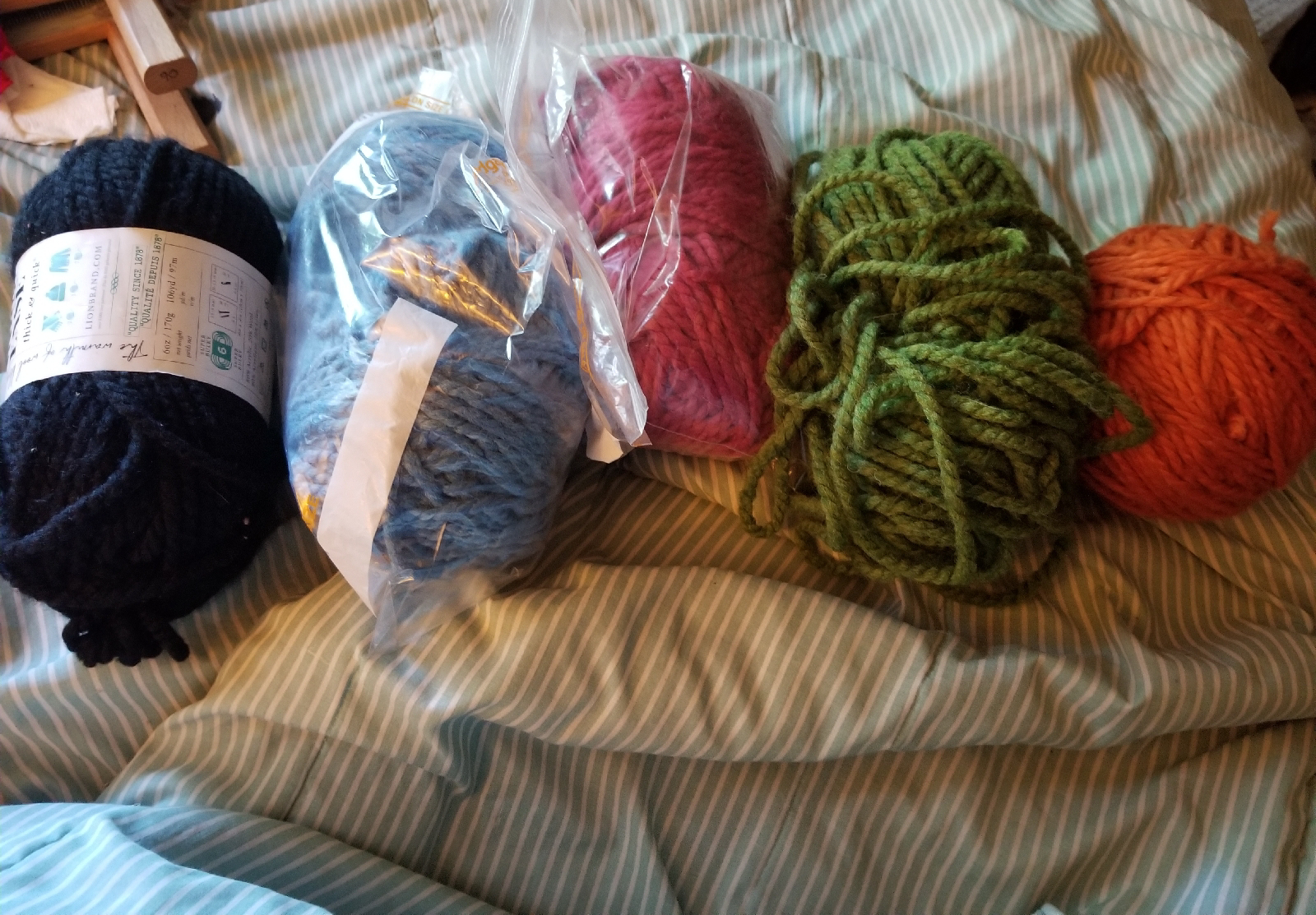
I bought quite a few odds and ends of Lionbrand Wool Ease Thick and Quick over the years. It's fun to experiment with. It technically does knit up quick, as people say.
However, I have to modify how I knit in order to use it.
I am an 'English Flicker' style knitter. I have also been slowly decreasing the needle size I use along with the thickness of yarn I use. With yarn this thick (super bulky), I have to knit continental, which can be uncomfortable and may even begin to make my hands sore. It's not as fun. It's not like I knit continental slowly through.

Anyways, the project is a simple garter stitch car blanket. You know, for emergencies. You fold it in thirds in order to tuck it into a pouch on the blanket itself. 
This post is about looking at needle sizes and color combinations to use up all this yarn I have.
I like this color combo as a color progression.

This second picture is my second choice. I like breaking up colors that are close on the color wheel. 
I suppose we'll see what combo I end up doing.
My problem is, I dont like using US size 13 needles with this yarn. I thought I had US size 15. But I guess not. I have a US size 17. I'll try both the 13 and the 17 and see which fabric I like better.

Until next time, Happy crafting! 

Monday, June 27, 2022

Octagonal scrap tatted doily

I could have sworn that I saw this pattern somewhere but I cant find it. The pattern was a bunch of tatted octagon flowers connected and joined. All of the motifs were from scraps. I will give you the pattern below. 


I can't have been dreaming it!
Oh well. I reproduced the idea from memory. 
These are a bunch of motifs made from scrap size 10 thread from other projects. 
Some are modern threads, like aunt lydia's size 10 for the red and navy. Others... are vintage threads from the 1960s to 1990s (I think.)

Here's a picture of me trying to squeeze the last amount of pink thread onto a cheap generic shuttle.
I did the decoupage myself. I forgot where I got the paper from. But it matches nicely, right? 

Pattern
Each motif is eight sided. Rings only.
Ring 1: 8- 4- 4 -8
Ring 2: 8 + 4 - 4 -8
Final ring (8): 8 + 4 -4 +8. (Join the last picot the first ring with a folded join).
Each ring is then joined at two points to its sibling motif.
There should be a square shaped space between the finished joined motifs.

Make it with me, if you have any scraps. It should be fun! 

-JT

Thursday, May 26, 2022

Jan Stawasz Doily 1 WIP

This is a very easy doily. Made in size 10 lizbeth white thread. The stitch definition is great, but the thread is not good for hiding ends. Quick tatted rounds!
This is an earlier picture of the doily. I will post the final in another post.

For this doily, I have taken to using the nail polish trick: knotting the ends and putting nail polish on the knot so it doesnt come unraveled. With a 3 ply thread, I would try weaving the ends, but Lizbeth thread is just so rigid.

I messed up so I had to un-tat an entire motif repeat. But since the thread is so smooth, it wasnt too bad to reopen all the rings. I just put on some podcasts to do it.

Unfortunately, the doily is just named 'Doily' in the book. I cant even give it a name. Maybe Jan Stawasz's 6 petal center doily? He reused motifs and patterns a lot so I don't even know! Maybe someone else knows what the official name for this pattern is.

I'm going to have to block and maybe iron this doily. At least I don't have to pull out the picots like I do with other threads. When a pattern has a ton of picots and it's a soft thread,  it's great to tat with but awful to block.
Anyway,  I've already used up one ball of Lizbeth thread. I'm using half a ball more. I may weigh the doily to see how much thread I used in making this. 

Farewell for know,
-JT

Saturday, February 12, 2022

Tussah silk spinning for a laceweight shawl

This is what I'm currently spinning. At least, one of my current spinning projects.

I have been working on this for several years on and off. I am spinning light laceweight natural colored tussah silk, in hopes to use it to knit a shawl. It is likely less expensive for me to spin my own silk laceweight that is fine enough for gossamer shetland, estonian and orenburg lace shawls.

The only silk gossamer weight I can find that is weaving cones, and it's often to heavy and very expensive. Maybe I'll buy it one day.

Here's my current spin! 
I'm using both a top whorl spindle and a supported spindle to try and get as thin as I can. It helps to make the project portable.

On the cardboard bobbin, you can see mulberry silk. I'm doing the same thing with it. I just need to respin it to make it thinner. I like working with the tussah silk more. It seems to be less slippery and has more 'tooth' to it.

The supported spindle is a dpn with a bead I bought. The top whorl spindle is a dowel with a hook and some polymer clay. I had fun making them and they spin very fast, but you have to practice a lot to make a good, fast, and balanced spindle.


One day I do plan to see how actual Victorian silk spindles work. They're like a bicone at the top,  and taper down. They are essentially top whorl spindles.

Anyway, I have more craft stuff to show, including tatting! Take care for now,

-JT

Monday, November 22, 2021

Crochet Terms: US to UK translation

Knitting terms seem standardized in the west from place to place, and country to country. Some stitches like moss stitch do mean different things in different countries.

However, crochet terms are a bit more difficult. Crochet is more of a recent craft, as it is generally 200 years old.

Crochet has different terminologies based on who created the pattern. UK, Europe and places exposed to crochet from these regions will have one, and the US and countries exposed to US terminology will have another. Here is a basic translation list between the two crochet terminologies.


US--------------------------------------UK

Chain (ch)                                      Chain (ch)
Slip stitch (sl st)                             Single crochet (sc)
Single crochet (sc)                         Double crochet (dc)
Half double crochet (hdc)              Half treble crochet (htc or htr)
Double crochet (dc)                       Treble crochet (Tc or trc)
Treble crochet (Tc or trc)               Double Treble crochet (dtr or dtc)
Double treble crochet (dtr or dtc)  Triple treble crochet (ttc)
etc.


And the list proceeds in a similar fashion with longer stitches. These are the basic stitches, hopefully this list helps.

Ways to tell if a pattern is using UK terms:

Mercifully, many pattern creators have this above mentioned key on their patterns. Some don't, and oftentimes, antique patterns don't have equivalent stitches listed.
This is one way that I'm able to tell if a pattern uses UK or US terms. First, look at the picture. Does it look like it has US single crochet? Does it look like it has slip stitches?

A pattern often starts with a chain X amount of stitches. After that, it will often say sc or dc. Do the first stitches in the picture look like sc or dc? If they look like sc but the pattern says dc, its a UK pattern. If the stitches look like sc and the patterns says sc, its a US pattern.

Another way to tell involves using old booklets. Old booklets from the Antique Pattern Library, Archive.org, and other sources often tell where the booklet was manufactured. It may say London, or Bristol (UK cities), or some similar place. If so, its safe to assume that UK terminology will be used.

If it says Chicago Ill, Boston MA, Florence MA, (US cities) or the like, its safe to assume that US terminology will be used.

If its a Canadian publication, (cities like Halifax, Toronto, etc), it seems to be a tossup on what terminology is used. Modern patterns will more likely have US style terminology, and antique patterns will more likely have UK style terminology.

Non-english language terminology can be translated from antique patterns as well, such as French. The translation will say something like 'single stitch', or 'double stitch'. In that case, it is harder, but again, look at the picture for clues.
In future, I'm hoping to have these stitch equivalents in other languages as well. God luck!


-jtp

Spring 2024 Renulek Doily part 2

So I'm making progress on this doily! Again, this is the spring 2024 doily by a tatting designer named Renulek .  This is rounds 1- 4 do...